← Back to Authors

Featured Author
David Miller
8 books in Langa
David Miller may refer to:
Books in Langa Library
8 books available from this author.
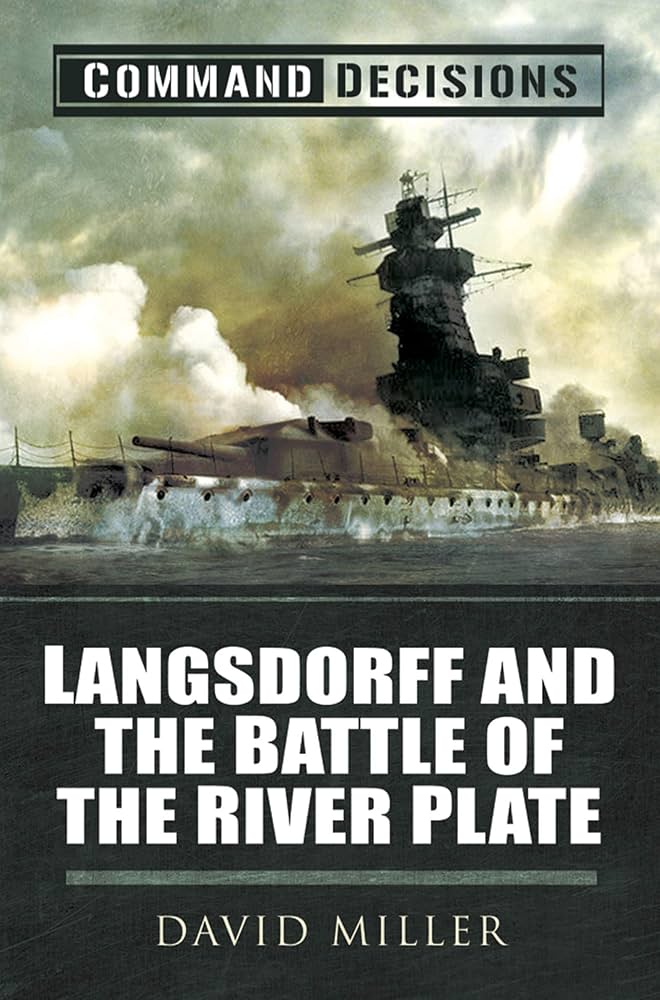
Command Decisions: Langsdorff and the Battle of the River Plate
Pen and Sword · 2013 · English · EPUB
This compelling new study of the Battle of the River Plate concentrates on Kapitn zur See Hans Langsdorff, the commander of the German pocket battleship Graf Spee it is written from his point of view. The story of his mission at the start of the Second World War to prey on merchant shipping is graphically retold, and Langsdorffs command decisions are the primary focus of David Millers gripping narrative. He considers in vivid detail the factors Langsdorff had to consider as he assessed the situation of his ship and choose his course of action. He describes the intelligence Langsdorff received and his knowledge of the position and strength of the forces of the Royal Navy that were arrayed against him. Langsdorffs interpretation of his mission and the tense calculations he had to make in order to carry it out are the essential elements of this dramatic story.
Langsdorff, operating alone and thousands of miles away from home and with no prospect of support, had to grapple with the enormous burden of a lone command. He made grave mistakes, and these are ruthlessly exposed. But this fascinating re-examination of his actions and his leadership does nothing to diminish his reputation as a brave and honourable officer.
+2
Is Self-Determination a Dangerous Illusion?
Polity Press · 2019 · English · EPUB
Claims to self-determination are rife in world politics today. They range from Scottish and Catalonian campaigns for independence to calls for the devolution of power to regions and cities. But is self-determination meaningful or desirable in the twenty-first century, or merely a dangerous illusion? In this book, David Miller mounts a powerful defence of political self-determination. He explains why it is valuable and argues that geographic proximity alone is not enough for groups to have the capacity for self-determination: group members must also identify with each other. He explores the different political forms that self-determination can take, and he suggests some realistic constraints on how it can be achieved, concluding that people exercising their collective agency is still both feasible and important. Anyone concerned by the theoretical issues raised by the various secessionist and nationalist movements around the world should read this book.
+1
Justice for Earthlings: Essays in Political Philosophy
Cambridge University Press · 2013 · English · EPUB
In the past few decades social changes have impacted how we understand justice, as societies become both more multicultural and more interconnected globally. Much philosophical thought, however, seems to proceed in isolation from these developments. While philosophers from Plato onwards have portrayed justice as an abstract, universal ideal, Miller argues that principles of justice are always rooted in particular social contexts, and connects these ideas to the changing conditions of human life. In this important contribution to political philosophy, it is argued that philosophers need to pay more attention to the way that people actually think about what's fair, and only defend principles that are feasible to apply in the real world. To understand equality of opportunity, for example, we must explore the cultural constraints that people face when presented with life choices. Justice for Earthlings also explains how national boundaries make justice at global level different from social justice.
**
Political Philosophy: A Very Short Introduction
OUP Oxford · 2003 · English · EPUB
This *Very Short Introduction* introduces readers to the key concepts of political philosophy: authority, democracy, freedom and its limits, justice, feminism, multiculturalism, and nationality. Accessibly written and assuming no previous knowledge of the subject, it encourages the reader to
think clearly and critically about the leading political questions of our time.
Miller first investigates how political philosophy tackles basic ethical questions such as 'how should we live together in society?' He furthermore looks at political authority, discusses the reasons society needs politics in the first place, explores the limitations of politics, and asks if there
are areas of life that shouldn't be governed by politics. Moreover, he explores the connections between political authority and justice, a constant theme in political philosophy, and the ways in which social justice can be used to regulate rather than destroy a market economy.
In his travels through this realm, Miller covers why nations are the natural units of government and wonders if the rise of multiculturalism and transnational co-operation will change all this, and asks in the end if we will ever see the formation of a world government.
**About the Series:** Combining authority with wit, accessibility, and style, **Very Short Introductions** offer an introduction to some of life's most interesting topics. Written by experts for the newcomer, they demonstrate the finest contemporary thinking about the central problems and issues in hundreds
of key topics, from philosophy to Freud, quantum theory to Islam.
**
+4
Rethinking Northern Ireland: Culture, Ideology and Colonialism
Routledge · 1998 · English · EPUB
**Rethinking Northern Ireland** provides a coherent and critical account of the Northern Ireland conflict. Most writing on Northern Ireland is informed by British propaganda, unionist ideology or currently popular 'ethnic conflict' paradigm which allows analysts to wallow in a fascination with tribal loyalty. **Rethinking Northern Ireland** sets the record straight by reembedding the conflict in Ireland in the history of an literature on imperialism and colonialism.
Written by Irish, Scottish and English women and men it includes material on neglected topics such as the role of Britain, gender, culture and sectarianism. It presents a formidable challenge to the shibboleths of contemporary debate on Northern Ireland. A just and lasting peace necessitates thorough re-evaluation and **Rethinking Northern Ireland** provides a stimulus to that urgent task.
Solved: How the World’s Great Cities Are Fixing the Climate Crisis
University of Toronto Press · 2020 · English · EPUB
If our planet is going to survive the climate crisis, we need to act rapidly.
Taking cues from progressive cities around the world, including Los Angeles, New York, Toronto, Oslo, Shenzhen, and Sydney, this book is a summons to every city to make small but significant changes that can drastically reduce our carbon footprint. We cannot wait for national governments to agree on how to reduce greenhouse gas emissions and manage the average temperature rise to within 1.5 degrees. In Solved, David Miller argues that cities are taking action on climate change because they can – and because they must. Miller makes a clear-eyed and compelling case that, if replicated at pace and scale, the actions of leading global cities point the way to creating a more sustainable planet.
Solved: How the World’s Great Cities Are Fixing the Climate Crisis demonstrates that the initiatives cities have taken to control the climate crisis can make a real difference in reducing global emissions if implemented worldwide. By chronicling the stories of how cities have taken action to meet and exceed emissions targets laid out in the Paris Agreement, Miller empowers readers to fix the climate crisis. As much a "how to" guide for policymakers as a work for concerned citizens, Solved aims to inspire hope through its clear and factual analysis of what can be done – now, today – to mitigate our harmful emissions and pave the way to a 1.5-degree world.
+6
The Cold War: A Military History
Random House · 1999 · English · EPUB
From 1949 to 1991 the world was overshadowed by the Cold War. Repeatedly it seemed that in days, even hours, global nuclear conflict would sweep away much of the United States, the Soviet Union and Europe. They would be obliterated in what President Carter described as 'one long, final and very bleak afternoon'. When the Cold War ended, the Warsaw Pact was wound up and the vast military forces which had flourished for over forty years were disbanded. As with all wars, however, it was only then that the realities of what had been involved began to emerge; indeed, much has remained hidden until now.
In The Cold War, David Miller discloses not only the vast scope of the military resources involved, but also how nearly threat came to terrible reality. Most chillingly of all, he reveals that while the menace of nuclear war predominated, it was actually little understood even by the experts. The book examines each military area in turn, covering the formation of the two great alliances, and the strategies and major weapons in the rival navies, armies and air forces. That the Cold War ended without a conflict was due to professionalism on both sides. The result, Miller suggests, would have impressed the Chinese military strategist, Sun Tsu, who, writing in the fifth century BC, said that 'to subdue the enemy without fighting is the acme of skill'.
+2