Langa
Library
LLanga Card
← Back to Authors
Featured Author

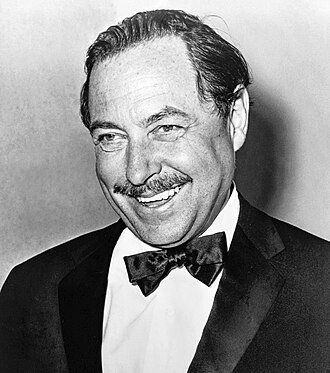
Tennessee Williams

American • Writer • Playwright
17 books in Langa

Thomas Lanier Williams III, known by his pen name Tennessee Williams, was an American playwright and screenwriter. Along with contemporaries Eugene O'Neill and Arthur Miller, he is considered among the three foremost playwrights of 20th-century American drama.

Domains
Literature
Tennessee Williams

Books in Langa Library

17 books available from this author.

27 Wagons Full of Cotton and Other Plays

27 Wagons Full of Cotton and Other Plays

New Directions Publishing · 1966 · English · EPUB

The thirteen one-act plays collected in this volume include some of Tennessee Williams's finest and most powerful work. They are full of the perception of life as it is, and the passion for life as it ought to be, which have made The Glass Menagerie and A Streetcar Named Desire classics of the American theater. Only one of these plays (The Purification) is written in verse, but in all of them the approach to character is by way of poetic revelation. Whether Williams is writing of derelict roomers in a New Orleans boarding house (The Lady of Larkspur Lotion) or the memories of a venerable traveling salesman (The Last of My Solid Gold Watches) or of delinquent children (This Property is Condemned), his insight into human nature is that of the poet. He can compress the basic meaning of life—its pathos or its tragedy, its bravery or the quality of its love—into one small scene or a few moments of dialogue. Mr. Williams's views on the role of the little theater in American culture are contained in a stimulating essay, "Something wild...," which serves as an introduction to this collection.
DramaAmerican
A House Not Meant to Stand: A Gothic Comedy

A House Not Meant to Stand: A Gothic Comedy

New Directions Publishing · 2008 · English · EPUB

The spellbinding last full-length play produced during the author's lifetime is now published for the first time. Christmas 1982: Cornelius and Bella McCorkle of Pascagoula, Mississippi, return home one midnight in a thunderstorm from the Memphis funeral of their older son to a house and a life literally falling apart--daughter Joanie is in an insane asylum and their younger son Charlie is upstairs having sex with his pregnant, holy-roller girlfriend as the McCorkles enter. Cornelius, who has political ambitions and a litany of health problems, is trying to find a large amount of moonshine money his gentle wife Bella has hidden somewhere in their collapsing house, but his noisy efforts are disrupted by a stream of remarkable characters, both living and dead. While Williams often used drama to convey hope and desperation in human hearts, it was through this dark, expressionistic comedy, which he called a "Southern gothic spook sonata," that he was best able to chronicle his vision of the fragile state of our world.
DramaAmericanGeneralFiction+3
A Streetcar Named Desire

A Streetcar Named Desire

New Directions Publishing · 2004 · English · EPUB

The Pulitzer Prize and Drama Critics Circle Award winning play—reissued with an introduction by Arthur Miller (Death of a Salesman and The Crucible), and Williams' essay "The World I Live In. " It is a very short list of 20th-century American plays that continue to have the same power and impact as when they first appeared—57 years after its Broadway premiere, Tennessee Williams' A Streetcar Named Desire is one of those plays. The story famously recounts how the faded and promiscuous Blanche DuBois is pushed over the edge by her sexy and brutal brother-in-law, Stanley Kowalski. Streetcar launched the careers of Marlon Brando, Jessica Tandy, Kim Hunter and Karl Malden, and solidified the position of Tennessee Williams as one of the most important young playwrights of his generation, as well as that of Elia Kazan as the greatest American stage director of the '40s and '50s. Who better than America's elder statesman of the theater, Williams' contemporary Arthur Miller, to write as a witness to the lightning that struck American culture in the form of A Streetcar Named Desire? Miller's rich perspective on Williams' singular style of poetic dialogue, sensitive characters, and dramatic violence makes this a unique and valuable new edition of A Streetcar Named Desire. This definitive new edition will also include Williams' essay "The World I Live In," and a brief chronology of the author's life.
DramaAmericanGeneralLgbtq
Caterpillar Dogs: And Other Early Stories

Caterpillar Dogs: And Other Early Stories

New Directions Publishing · 2023 · English · EPUB

Seven previously unpublished stories of the Great Depression by America’s poet laureate of the lost These tales were penned by one Thomas Lanier Williams of Missouri before he became a successful playwright, and yet his voice is unmistakable. The reliable idiosyncrasies and quiet dignity of Williams’s eccentrics are already present in his characters. Consider the diminutive octogenarian of “The Caterpillar Dogs,” who may have just met her match in a pair of laughing Pekinese that refuse to obey; the retired, small-town evangelist in “Every Friday Nite is Kiddies Nite,” who wears bright-colored pajamas and receives a message from God to move to St. Louis and finally, finally go to the movies again; or the distraught factory worker whose stifled artistic spirit, and just a soupçon of the macabre, propel the drama of “Stair to the Roof.” Love’s diversions and misdirections, even autoerotic longings, are found in these delightful lagniappes: in “Season of Grapes,” the intoxicating ripeness of summer in the Ozarks acquaints one young man with his own passions, which turn into a fever dream, and the first revelation of female sexuality blooms for a college boy in “Ironweed.”Is there such a thing as innocence? Apparently in the 1930s there was, and Williams reveals it in these stories.
FictionClassicsDramaAmerican+4
Clothes for a Summer Hotel: Play

Clothes for a Summer Hotel: Play

New Directions Publishing · 1983 · English · EPUB

This late play by Tennessee Williams explores the troubled relationship between F. Scott and Zelda Fitzgerald. The late Tennessee Williams’s Clothes for a Summer Hotelmade its New York debut in 1980. Here Scott and Zelda Fitzgerald, often seen as symbols of the doomed youth of the jazz age, become two halves of a single creative psyche, each part alternately feeding and then devouring the other. Set in Highland Hospital near Asheville, North Carolina, where Zelda spent her last confinement, this "ghost play" begins several years after Scott’s death of a heart attack in California. But the past is "still always present" in Zelda, and Williams’s constant shifting of chronology and mixing of remembrance with ghostly re-enactment suggest that our real intimacy is with the shadow characters of our own minds. As Williams said in the Author’s Note to the Broadway production: "Our reason for taking extraordinary license with time and place is that in an asylum and on its grounds liberties of this kind are quite prevalent: and also these liberties allow us to explore in more depth what we believe is truth of character. " Williams poses the inevitable, unanswerable questions: Did Scott prevent Zelda from achieving an independent creativity? Did Zelda’s demands force Scott to squander his talents and turn to alcohol? Whose betrayal––emotional, creative, sexual––destroyed the other? But he poses these questions in a new way: in the act of creation, Zelda and Scott are now aware of their eventual destruction, and the creative fire that consumed two artists combines symbolically with the fire that ended Zelda’s life.
DramaAmericanGeneralFiction+3
Not About Nightingales

Not About Nightingales

New Directions Publishing · 1998 · English · EPUB

This early full-length play put a young Tennessee Williams' passion for social justice in the spotlight. "Haunting, searing, unforgettable" —London Herald In early 1998, sixty years after it was written, one of Tennessee Williams' first full-length plays, Not About Nightingales, was premiered by Britain's Royal National Theatre and was immediately hailed as "one of the most remarkable theatrical discoveries of the last quarter century (London Evening Standard). Brought to the attention of the director Trevor Nunn by the actress Vanessa Redgrave (who has contributed a Foreword to this edition), "this early work...changed our perception of a major writer and still packs a hefty political punch" (London Independent). Written in 1938 and based on an actual newspaper story, the play follows the events of a prison atrocity which shocked the nation: convicts leading a hunger strike in a Pennsylvania prison were locked in a steam-heated cell and roasted to death. Williams later said: "I have never written anything since that could compete with it in violence and horror. " Its sympathetic treatment of black and homosexual characters may have kept the play unproduced in its own time. But its flashes of lyricism and compelling dialogue presage the great plays Williams has yet to write. Not About Nightingales shows us the young playwright (for the first time using his signature "Tennessee") as a political writer, passionate about social injustice, and reflecting the plight of outcasts in Depression America. The stylistic influences of European Expressionism, radical American theatre of the 1930s, and popular film make it unique among the group of four early plays. Not About Nightingales has been edited by eminent Williams scholar Allean Hale, who has also provided an illuminating historical introduction.
DramaAmericanGeneralFiction+2
Orpheus Descending and Suddenly Last Summer

Orpheus Descending and Suddenly Last Summer

New Directions Publishing · 2012 · English · EPUB

Two of Tennessee Williams's most revered dramas in a single paperback edition for the first time. Orpheus Descending is a love story, a plea for spiritual and artistic freedom, as well as a portrait of racism and intolerance. When charismatic drifter Valentine Xavier arrives in a Mississippi Delta town with his guitar and snakeskin jacket, he becomes a trigger for hatred and a magnet for three outcast souls: storekeeper Lady Torrance, “lewd vagrant” Carol Cutrere, and religious visionary Vee Talbot. Suddenly Last Summer, described by its author as a “short morality play,” has become one of his most notorious works due in no small part to the film version starring Elizabeth Taylor, Katharine Hepburn, and Montgomery Clift that shocked audiences in 1959. A menacing tale of madness, jealousy, and denial,the horrors in Suddenly Last Summer build to a heart-stopping conclusion. With perceptive new introductions by playwright Martin Sherman — he reframes Orpheus Descending in a political context and explores the psychology and sensationalism surrounding Suddenly Last Summer — this volume also offers Williams’s related essay, “The Past, the Present, and the Perhaps,” and a chronology of the playwright’s life and works.
DramaAmericanFictionLiterary+2
Something Cloudy, Something Clear

Something Cloudy, Something Clear

New Directions Publishing · 1996 · English · EPUB

Tennessee Williams returns to a pivotal moment in his stormy youth in Something Cloudy, Something Clear, which introducer Eve Adamson calls "a delicately woven tapestry of past and present, vulnerability and toughness, impetuous action and mature insight. " Something Cloudy, Something Clear is, as Tennessee Williams stated, "one of the most personal plays I’ve ever written. " Set in Provincetown, Cape Cod, in 1940, the play records Williams’ experiences during that "pivotal summer when I took sort of a crash course in growing up. " On the brink of becoming a successful playwright, Williams was also to "come thoroughly out of the closet" and meet Kip, his first great love. Something Cloudy, Something Clearbrilliantly reimagines that long ago time, now recollected through the filter of all the playwright’s successes and failures, joys and regrets. Eve Adamson, director of the original 1981 production, provides an insightful introduction in which she captures the play’s heart-breaking appeal: "It is a delicately woven tapestry of past and present, vulnerability and toughness, impetuous action and mature insight. It seeks a reconciliation between love and art, life and death, and-to use two phrases which recur in the play––exigencies of desperation and negotiation of terms. The cloudy and the clear. "
DramaAmericanGeneralLgbtq+2
Stairs to the Roof

Stairs to the Roof

New Directions Publishing · 2000 · English · EPUB

A play produced only twice in the 1940s and now published for the first time reveals that Tennessee Williams anticipated the themes of Star Trek by decades. Sixty years ago a young Tennessee Williams wrote a play looking toward the year 2001. Stairs to the Roof is a rare and different Williams' work: a love story, a comedy, an experiment in meta-theater, with a touch of early science fiction. Tennessee Williams called Stairs to the Roof "a prayer for the wild of heart who are kept in cages" and dedicated it to "all the little wage earners of the world. " It reflects the would-be poet's "season in hell" during the Depression when he had to quit college to type orders eight hours a day at the International Shoe Factory in St. Louis. Stairs is Williams' revenge, expressed through his alter ego, Benjamin Murphy, the clerk who stages a one-man rebellion against the clock, the monotony of his eight-to-five job, and all the dehumanizing forces of an increasingly mechanized and commercial society. Ben's swift-moving series of fantastic adventures culminate in an escape from the ordinary that is an endorsement of the American dream. In 1941 with the world at war and civilization in danger of collapse, Williams dared to imagine a utopian future as Ben leads us up his stairs towards the Millennium. Stairs to the Roof was produced only twice, once at the Playbox in Pasadena, California, in 1945, and subsequently at the Pasadena Playhouse in 1947. Now, in an edition meticulously prepared by noted Williams scholar Allean Hale, Williams fans can share this play of youthful optimism.
DramaAmericanGeneralFiction+3
Suddenly Last Summer and Other Plays

Suddenly Last Summer and Other Plays

Penguin Books Limited · 2014 · English · EPUB

These three dramatic works by Tennessee Williams explore the darker side of human nature and are haunted by a sense of isolation and regret. 'Suddenly Last Summer' is the starkly told story of Catherine, who seemingly goes insane after her cousin Sebastian dies in grisly circumstances on a trip to Europe. 'The Milk Train Doesn't Stop Here Anymore' is a passionate examination of a wealthy old woman as she recounts her memories in the face of death, while in 'Small Craft Warnings' a motley group of people - including a blowsy beautician, a discredited alcoholic doctor, a vulnerable waif and two gay men - sit around a seedy bar on the Californian coast, each contemplating their own desperate fate.
DramaAmericanGeneral
Sweet Bird of Youth

Sweet Bird of Youth

New Directions Publishing · 2008 · English · EPUB

Now with an insightful new introduction, the author's original Foreword, and the one-act play, The Enemy: Time, on which Sweet Bird of Youth was based. Tennessee Williams knew how to tell a good tale, and this steamy, wrenching play about a faded movie star, Alexandra Del Lago, and about the lost innocence and corruption of Chance Wayne, reveals the dark side of the American dreams of youth and fame. Distinguished American playwright Lanford Wilson has written an insightful Introduction for this edition. Also included are Williams’ original Foreword to the play; the one-act play The Enemy: Time—the germ for the full-length version, published here for the first time; an essay by Tennessee Williams scholar, Colby H. Kullman; and a chronology of the author’s life.
DramaAmericanGeneralFiction+1
The Glass Menagerie

The Glass Menagerie

New Directions Publishing · 1999 · English · EPUB

No play in the modern theatre has so captured the imagination and heart of the American public as Tennessee Williams's The Glass Menagerie. Menagerie was Williams's first popular success and launched the brilliant, if somewhat controversial, career of our pre-eminent lyric playwright. Since its premiere in Chicago in 1944, with the legendary Laurette Taylor in the role of Amanda, the play has been the bravura piece for great actresses from Jessica Tandy to Joanne Woodward, and is studied and performed in classrooms and theatres around the world. The Glass Menagerie (in the reading text the author preferred) is now available only in its New Directions Paperbook edition. A new introduction by prominent Williams scholar Robert Bray, editor of The Tennessee Williams Annual Review, reappraises the play more than half a century after it won the New York Drama Critics Circle Award: "More than fifty years after telling his story of a family whose lives form a triangle of quiet desperation, Williams's mellifluous voice still resonates deeply and universally. " This edition of The Glass Menagerie also includes Williams's essay on the impact of sudden fame on a struggling writer, "The Catastrophe of Success," as well as a short section of Williams's own "Production Notes. " The cover features the classic line drawing by Alvin Lustig, originally done for the 1949 New Directions edition.
DramaAmericanGeneralLgbtq+3
The Notebook of Trigorin: A Free Adaptation of Chechkov's the Sea Gull

The Notebook of Trigorin: A Free Adaptation of Chechkov's the Sea Gull

New Directions Publishing · 1997 · English · EPUB

Tennessee Williams freely adapts Anton Chekhov's Russian classic "The Seagull". From the master twentieth-century playwright Tennessee Williams-an adaptation of Chekhov's The Sea Gull, never before available to the general trade. The Notebook of Trigorin is faithful to Chekhov's story of longing and unrequited love. Set on a provincial Russian Estate, its peaceful environs offer stark contrast to the turbulent lives of its characters. Constantine, a young writer, must compete for the attention of his mother, a self-obsessed, often comical aging actress, Madame Arkadina, and his romantic ideal, Nina. His rival for both women is Trigorin, an established author bound to Arkadina by her patronage of his work, and attracted to Nina by her beauty. Trigorin cannot keep himself from consuming everything of value in Constantine's life. Only in the final scenes do all discover that the price for love and fragility can be horribly high. But if the words in The Notebook of Trigorin are essentially Chekhov's, the voice belongs firmly to Tennessee Williams. The dialogue resonates with echoes of the themes Williams developed as his signatures-compassion for the artistic soul and its vulnerability in the face of the world's "successfully practiced duplicity" (Act I).
DramaAmericanGeneralRussian & Soviet
The Roman Spring of Mrs. Stone

The Roman Spring of Mrs. Stone

New Directions Publishing · 1993 · English · EPUB

Published in 1950, his first novel was acclaimed by Gore Vidal as "Splendidly written, precise, short, complete and fine. " It is the story of a wealthy, fiftyish American widow, recently a famous stage beauty, but now "drifting. " The novel opens soon after her husband's death and her retirement from the theatre, as Mrs. Stone tries to adjust to her aimless new life in Rome. She is adjusting, too, to aging ("The knowledge that her beauty was lost had come upon her recently and it was still occasionally forgotten. ") With poignant wit and his own particular brand of relish, Williams charts her drift into an affair with a cruel young gigolo: "As compelling, as fascinating, and as technically skilled as his plays. " (Publishers Weekly)
FictionLiteraryLiterary CriticismGeneral
The Traveling Companion and Other Plays

The Traveling Companion and Other Plays

New Directions Publishing · 2008 · English · EPUB

Even with his great commercial success, Tennessee Williams always considered himself an experimental playwright. In the last 25 years of his life his explorations increased--especially in shorter forms and one-act plays--as Williams created performance pieces with elements of theater of the absurd, theater of cruelty, theater of the ridiculous, as well as motifs from Japanese forms such as Noh and Kabuki, high camp and satire, and with innovative visual and verbal styles that were entirely his own. Influenced by Beckett, Genet, and Pinter, among others, Williams worked hard to expand the boundaries of the lyric realism he was best known for. These plays were explicitly intended to be performed off-off Broadway or regionally. Sometimes disturbing, sometimes outrageous, quite often the tone of these plays is rough, bawdy or even cartoonish. While a number of these plays employ what could be termed bizarre "happy endings," others gaze unblinkingly into the darkness. Though several of Williams' lesser-known works from this period have already been published by New Directions, these twelve plays have never been collected. Most of these shorter plays are unknown to audiences and scholars--some are published here for the first time--yet all of them embrace, in one way or another, what Time magazine called "the four major concerns that have spurred Williams' dramatic imagination: loneliness, love, the violated heart and the valiancy of survival. "
DramaAmericanGeneralLgbtq+3
The Two-Character Play

The Two-Character Play

New Directions Publishing · 1979 · English · EPUB

A classic play by Tennessee Williams in a definitive, author-approved edition. Reality and fantasy are interwoven with terrifying power as two actors on tour—brother and sister—find themselves deserted by the trope in a decrepit "state theatre in an unknown state. " Faced (perhaps) by an audience expecting a performance, they enact "The Two-Character Play"—an illusions within an illusion, and "out cry" from isolation, panic and fear. "I think it is my most beautiful play since Streetcar," Tennessee Williams said, "and I've never stopped working on it....It is a cri de coeur, but then all creative work,all life, in a sense is a cri de coeur. " In the course of its evolution, several earlier versions of The Two-Character Play have been produced. The first of them was presented in 1967 in London and Chicago and brought out in 1969 by New Directions in a signed limited edition. The next, staged in 1973 in New York under the title Out Cry, was published by New Directions in 1973 The third version (New York, 1975), again titled The Two-Character Play, is the one Tennessee Williams wished to include in New Directions' The Theatre of Tennessee Williams series. It is this version which is presented in this ND paperback.
DramaAmericanGeneralFiction+1
Vieux Carre

Vieux Carre

New Directions Publishing · 2000 · English · EPUB

Born out of the journals the playwright kept at the time, Tennessee Williams's Vieux Carré is not emotion recollected in tranquility, but emotion re-created with all the pain, compassion, and wry humor of the playwright's own 1938-39 sojourn in the New Orleans French Quarter vividly intact. The drama takes it form from the shifting scenes of memory, and Williams's surrogate self invites us to focus, in turn, on the various inhabitants or his dilapidated rooming house in the Vieux Carré: the comically desperate landlady, Mrs. Wire; Jane, a properly brought-up young woman from New York making at last grab at pleasure with Tye, the vulgar but appealing strip-joint barker; two decayed gentlewomen politely starving in the garret; and the dying painter Nightingale, who tries to teach the young writer something about love--both of the body and of the heart. This is a play about the education of the artist, and education in loneliness and despair, in giving and not giving, but most of all in seeing, hearing, feeling, and learning that "writers are shameless spies," who pay dearly for their knowledge and who cannot forget. Building on two decades of Williams scholarship since Vieux Carré was originally published, Robert Bray, editor of The Tennessee Williams Annual Review, has provided a new introduction for this edition, giving the most authoritative account yet of its background and genesis.
DramaAmericanGeneralFiction+1